
Choosing the best AI SDR software in 2026 can be confusing because different tools offer different levels of sales automation. Some help sales teams write personalised emails, while others manage prospect research, contact enrichment, outreach campaigns, and incoming responses.
The challenge is determining which capabilities your business actually needs.
An AI SDR platform that works well for a lead generation agency may not be the right choice for a startup managing its first outbound campaigns. Differences in team size, budget, outreach volume, and human oversight all influence the decision.
This guide explains the five main types of AI SDR software, what to consider when comparing platforms, and how agencies and startups can evaluate available options. It also includes a weighted comparison scorecard, practical vendor questions, and a two-week trial process to help you make an informed decision.
What Is AI SDR Software?
AI SDR software uses artificial intelligence to support tasks traditionally performed by sales development representatives. Depending on the platform, these tasks may include identifying prospects, researching companies, enriching contact information, drafting outreach messages, managing follow-ups, and organising sales conversations.
However, not every AI SDR tool performs all these functions.
Some products focus on individual activities, such as creating email copy or gathering prospect data. Others coordinate multiple stages of the outbound sales process.
This distinction is important because the features advertised by a provider may not reflect how much manual work its software actually removes.
For businesses evaluating AI sales automation, the first step is understanding the different types of tools available.
Five Types of AI SDR Software to Consider in 2026
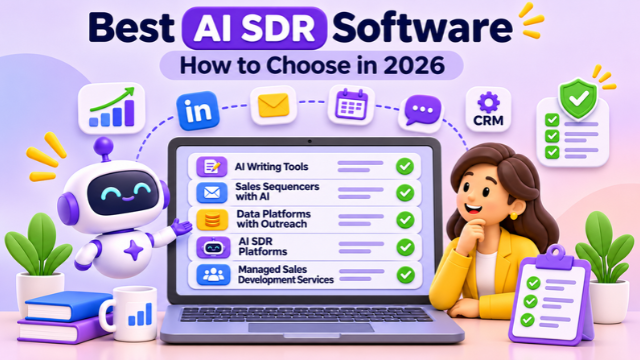
AI SDR tools generally fall into five categories. Although some platforms combine features from multiple categories, understanding these differences can help narrow your options.
1. AI Writing Tools
AI writing tools help sales representatives create outreach content.
They can generate subject lines, personalised opening messages, follow-up emails, and complete sequences using information supplied by the user.
These tools are useful for businesses with an established sales process that primarily need assistance with content creation.
However, most standalone writing tools do not handle prospect discovery, contact verification, campaign execution, or reply management.
Your team must continue using other systems for those activities.
2. Sales Sequencers With AI Features
Sales sequencing platforms manage scheduled outreach and follow-up activities.
Some now include AI features for generating messages, personalising campaigns, or classifying incoming responses.
They are suitable for teams that already have reliable prospect data and want to improve their existing outreach processes.
The main limitation is that research and contact enrichment may still require separate tools.
3. Data Platforms With Outreach Capabilities
Contact data platforms focus on identifying businesses and individuals who match your target audience.
They may offer contact databases, company information, enrichment services, and email verification.
Some also include basic campaign management features.
These platforms are useful when a business's primary challenge is finding accurate prospect information.
However, their outreach and response-management capabilities may be less comprehensive than those of dedicated sales engagement platforms.
4. Autonomous AI SDR Platforms
Autonomous AI SDR platforms coordinate several stages of the sales development process.
Depending on the product, they can help users discover prospects, enrich contact records, build outreach campaigns, manage follow-ups, and classify responses.
Some allow selected activities to run automatically, while others require human approval before external communications are sent.
These platforms are particularly relevant to businesses trying to reduce repetitive sales administration across multiple tools.
Their value depends on data accuracy, workflow reliability, and the level of control available to users.
5. Managed Sales Development Services Using AI
Managed sales development services combine technology with external specialists who operate outbound campaigns.
The provider may use AI for research, personalisation, campaign management, and reporting.
This model can be useful for businesses without the internal resources to manage outbound sales.
However, it usually provides less direct control over campaign execution and creates greater dependence on the service provider.
AI SDR Software Comparison
The best option depends on whether your team needs help with a specific task or a broader system for managing sales development.
What Should You Look for in the Best AI SDR Software?
Once you understand the different software categories, compare the features that directly affect your sales process.
Rather than selecting a tool based on the number of advertised capabilities, evaluate how well those features work together.
Prospect Discovery and Data Quality
Accurate prospect information is essential for successful outreach.
Look for software that helps identify relevant companies, find decision-makers, and verify contact details before campaigns begin.
Ask how frequently data is updated, which sources are used, and what happens when contact information cannot be verified.
A platform that provides thousands of contacts offers limited value if your team must manually correct much of the information.
Multichannel Outreach Capabilities
Many sales teams communicate with prospects across several channels, including email, LinkedIn, and phone.
AI SDR software may help coordinate activities across these channels, but the level of integration varies.
Some platforms manage email and LinkedIn sequences from one interface. Others provide reminders or queued tasks for manual phone follow-ups.
Check which activities are automated and which require human participation.
Also confirm whether the platform's integration methods comply with applicable third-party service policies.
Human Approval and Campaign Control
AI-generated outreach should reflect your brand and use accurate information.
Look for tools that allow users to review messages, adjust campaign settings, and control which activities require approval.
This is particularly important when sending highly personalised messages or communicating on behalf of senior team members.
An effective platform should make it clear what happens automatically and what remains under human supervision.
Reply Management and Follow-Ups
Managing responses is an important part of outbound sales.
A useful AI SDR platform should help organise conversations, identify prospects who require attention, and prevent inappropriate follow-ups after someone replies or opts out.
Some platforms also classify responses according to intent, helping sales representatives prioritise their work.
Evaluate how accurately the classifications work and whether users can correct mistakes.
CRM Integration and Reporting
AI SDR software should fit into the tools your team already uses.
Check whether it supports your CRM, how contact information is synchronised, and whether campaign results can be measured consistently.
Reporting should provide insight into relevant outcomes, such as qualified replies, meetings booked, and sales opportunities created.
The objective is to understand whether the software is improving sales operations rather than simply increasing activity.
How to Compare AI SDR Software Using a Weighted Scorecard
A weighted scorecard can make software comparisons more objective.
Instead of treating every feature as equally important, assign greater value to the capabilities most relevant to your business.
For example, an agency may prioritise client management and reporting, while a startup may place greater importance on setup time and cost.
Score each platform from 1 to 5 for every criterion:
- 1: Poor or unavailable
- 2: Limited functionality
- 3: Meets basic requirements
- 4: Strong functionality
- 5: Fully meets your requirements
Then apply an importance weight of 3 for high, 2 for medium, 1 for low, or 0 for unnecessary features.
AI SDR Software Evaluation Scorecard
Multiply each platform's performance score by the corresponding importance weight, then add the results.
For example, if client separation has a high importance weight of 3 and a platform receives a performance score of 5, that criterion contributes 15 points.
Apply the same method across all criteria to identify the software that best matches your requirements.
This approach also helps expose trade-offs. A platform may provide stronger automation but weaker financial predictability, while another may have fewer features but fit your existing workflow better.
How to Choose AI SDR Software for a Lead Generation Agency
Lead generation agencies often manage campaigns for several clients simultaneously.
This creates additional requirements around account separation, branding, reporting, and operational efficiency.
One of the most important considerations is whether the platform provides individual client workspaces.
Each client should have appropriate separation between contacts, campaigns, sending accounts, permissions, and suppression lists.
Agencies should also evaluate the quality of client-facing reports. White-label features can be helpful, but their scope varies. Some platforms allow basic logo customisation, while others provide branded dashboards and reporting environments.
Sender controls are another important consideration.
An agency must manage multiple campaigns responsibly while maintaining appropriate email authentication, contact verification, suppression management, and sending practices.
Finally, consider the software's impact on operating costs.
Measure how much your team spends on prospect research, campaign preparation, and response management. Then compare those costs against the number of qualified meetings or sales opportunities generated.
A platform that reduces manual research but leaves reply management unchanged may provide less operational value than one that improves both activities.
The best AI SDR software for agencies should make client management easier without compromising data separation, campaign quality, or oversight.
How to Choose AI SDR Software for a Startup
Startups usually have smaller sales teams and more limited resources.
For these businesses, AI SDR software should be straightforward to use, affordable to operate, and flexible enough to support an evolving sales process.
Start by evaluating how quickly the platform can prepare a campaign.
Can your team identify a target audience, prepare messages, and configure outreach without extensive onboarding or technical support?
Next, examine the quality of AI-generated content.
When founders or early sales representatives communicate directly with prospects, inaccurate claims or irrelevant personalisation can affect important relationships.
Human approval is therefore a useful starting point.
Contact verification also matters because startups may have limited time and budget for correcting inaccurate information.
Rather than focusing on the largest possible contact database, prioritise relevant prospect research and dependable enrichment capabilities.
Finally, look closely at pricing.
Consider the subscription cost, data credits, sending infrastructure, and other usage charges. A platform with an inexpensive entry plan may become costly as campaign activity increases.
For startups, a manageable workflow and predictable expenses can be more important than access to every advanced automation feature.
Can AI SDR Software Guarantee Account Safety and Email Deliverability?
AI SDR software cannot guarantee that LinkedIn accounts will remain unrestricted or that every email will reach its intended inbox.
These outcomes depend on platform policies, sending practices, contact quality, and other factors beyond the software provider's control.
LinkedIn applies restrictions intended to prevent spam and misuse. It does not publicly establish a single weekly invitation limit that applies to every account.
Importantly, staying below an unofficial invitation threshold does not automatically make automated activity acceptable.
LinkedIn restricts unauthorised third-party tools that automate certain activities on its platform.
Businesses evaluating AI SDR products should review the vendor's integration methods and relevant platform policies before enabling automation.
Email deliverability requires similar attention.
Google's email sender guidelines emphasise authentication, responsible sending behaviour, spam complaint management, and appropriate unsubscribe mechanisms.
AI SDR software may help support these practices through verification, suppression controls, and sending management.
However, no platform can promise unrestricted delivery.
When evaluating vendors, favour transparent explanations of account controls and compliance considerations over guarantees that cannot be supported.
Five Questions to Ask Before Buying AI SDR Software
Product demonstrations can make almost any platform appear effective.
To understand how the software performs in practice, ask vendors questions about real workflows rather than general feature availability.
1. Which Tasks Run Automatically?
Ask the vendor to demonstrate exactly which activities require human approval.
Can the platform research prospects independently? Does it automatically enrol contacts in campaigns? Can approval requirements be adjusted?
These answers help determine how much oversight your team will need.
2. How Does the Software Research Prospects?
Ask where contact information comes from and whether users can review the research used to generate personalised messages.
A platform should help users identify inaccurate data before it affects external communications.
3. What Happens When Someone Replies?
Ask the vendor to demonstrate how incoming replies affect an active sequence.
Check whether follow-ups stop appropriately and whether responses are organised for review.
If the platform uses AI classification, confirm how mistakes can be corrected.
4. How Are Unsubscribes Managed?
Ask whether contacts who opt out are prevented from being included in later campaigns.
Understand how suppression lists apply across campaigns, teams, and workspaces.
The process should support the organisation's applicable compliance responsibilities.
5. What Will the Software Cost at Our Expected Volume?
Provide realistic figures for your users, contacts, sending accounts, and expected activity.
Ask for a detailed explanation of subscription fees, usage charges, and possible additional costs.
A clear pricing model is essential for comparing total operating expenses.
How to Test AI SDR Software Before Making a Decision
A structured trial can help determine whether a platform fits your existing sales process.
Instead of exploring features without a plan, divide the evaluation into four stages.
Days 1–3: Set Up the Platform
Connect the necessary systems and prepare a targeted prospect list.
Choose one audience and a clearly defined offer.
Evaluate how easily you can research contacts, enrich information, and create a campaign.
Record the time required and any support your team needs.
Days 4–7: Review Outreach Quality
Prepare a campaign with human approval enabled.
Check whether the generated messages are accurate, relevant, and appropriate for the intended audience.
Monitor the number of drafts requiring significant corrections.
A platform should reduce unnecessary manual work without sacrificing quality.
Days 8–11: Evaluate Campaign Management
Assess how the software manages active campaigns and incoming responses.
Test reply classification, suppression handling, and follow-up controls where appropriate.
If the platform supports multiple channels, evaluate those capabilities using compliant methods.
Consider whether the interface is practical for daily use.
Days 12–14: Compare Results and Costs
Review the platform against your original evaluation criteria.
Measure setup time, data accuracy, message quality, response management, and actual spending.
If the campaign generates qualified meetings, calculate the cost per meeting.
Cost per booked meeting = Total attributable campaign cost ÷ Qualified meetings booked
For example, a campaign costing £600 and generating six qualified meetings has a cost per booked meeting of £100.
This is an illustrative calculation rather than an industry benchmark.
A two-week trial can provide useful information about usability and workflow quality, but it may not be long enough to establish reliable performance benchmarks.
If the results are inconclusive, extend the evaluation rather than making a decision based on insufficient data.
How Much Does AI SDR Software Cost?
AI SDR software pricing varies depending on its capabilities, usage model, and intended customers.
Understanding how providers charge is important because the advertised subscription price may represent only part of the total expense.
Per-Seat Pricing
Per-seat pricing charges according to the number of users or licences.
This approach can work well for sales teams where each representative manages an individual pipeline.
However, expenses may rise as the team expands.
Usage-Based Pricing
Usage-based platforms charge for measurable activities such as contact enrichment, data requests, or selected AI operations.
This approach allows costs to reflect actual usage, but businesses should understand which activities consume credits.
Ask whether usage limits, spending reports, and warnings are available.
Performance-Based Pricing
Some providers charge according to booked meetings or other agreed outcomes.
This may appear attractive because fees are connected to campaign performance.
However, businesses should clarify what qualifies as a billable meeting and how cancellations, no-shows, or unqualified prospects are handled.
When comparing AI SDR tools, consider subscription fees alongside contact data expenses, infrastructure requirements, implementation time, and ongoing management costs.
The most useful comparison is total operating cost relative to qualified sales opportunities and business value.
Where Does Salesflow's Ariel Fit Among AI SDR Platforms?
Salesflow's Ariel is positioned as an AI SDR that brings multiple stages of outbound sales development into a connected workflow.
Built on Salesflow's outbound platform, Ariel combines AI-assisted prospecting, data enrichment, campaign preparation, and response management.
Unlike a standalone AI writing tool, its role extends into broader sales development activities.
AI-Powered Prospect Discovery
Ariel allows users to describe their target audience in natural language and prepare prospecting workflows.
Its product materials describe AI-assisted search, contact discovery, company research, and lookalike prospecting.
These capabilities can help sales teams identify relevant companies and potential decision-makers while reducing manual research.
Users can review prospect information before proceeding with enrichment or campaign activities.
Contact Enrichment and Verification
Ariel supports contact enrichment using multiple data sources.
This can help teams identify email addresses and other relevant contact details for their outbound campaigns.
Verification is an important part of the process, although information quality and availability depend on the underlying providers.
Businesses evaluating Ariel should confirm how enrichment attempts are charged and how unsuccessful requests are handled.
Living Lists and Intent-Based Prospecting
Ariel's product materials describe saved prospecting workflows and account-level intent signals.
These features are intended to help sales teams identify potentially relevant companies and maintain prospecting activity without manually repeating every search.
The exact signal definitions, refresh schedules, and list-update behaviour should be confirmed during a product demonstration.
Multichannel Campaign Management
Ariel supports workflows involving email, LinkedIn, and phone-related sales activity.
The platform aims to coordinate these activities while allowing teams to manage outreach settings and human approval requirements.
Users should distinguish automated campaign actions from tasks that require a sales representative, such as manually placed phone calls.
As with any multichannel platform, organisations should confirm that the integration methods they intend to use comply with applicable policies.
Unified Inbox and Reply Classification
Ariel's unified inbox helps organise prospect responses and provides AI-assisted classification.
These capabilities can help sales teams identify interested prospects, objections, and conversations requiring follow-up.
The system is designed to reduce the effort involved in sorting replies across campaigns.
Human review remains important for complex or sensitive conversations.
Human Approval and Campaign Oversight
Ariel's review-first approach allows users to evaluate AI-prepared messages before they are sent.
Its product materials also describe review workflows designed to make pending actions easier to manage.
For agencies and startups, these controls can help balance operational efficiency with brand oversight.
Overall, Ariel is most relevant to businesses exploring a connected AI SDR workflow rather than a tool limited to email copy generation.
Organisations can evaluate its suitability by reviewing their existing processes, campaign volume, approval requirements, and available integrations.
How to Choose the Right AI SDR Software for Your Business
The best AI SDR software is the one that addresses your actual sales development requirements.
Begin by identifying the tasks consuming the most time. Determine whether your team needs better prospect data, improved outreach management, assistance with replies, or broader workflow automation.
Then shortlist products that address those needs.
Use the weighted scorecard to compare relevant capabilities, ask vendors to demonstrate real workflows, and evaluate pricing based on expected activity.
Where possible, test the leading options before committing to a longer contract.
Pay particular attention to data accuracy, campaign controls, integration reliability, and the amount of manual work remaining after implementation.
A good product should help your sales team spend less time managing repetitive tasks and more time working on meaningful sales conversations.
Frequently Asked Questions
What Is the Best AI SDR Software for Lead Generation Agencies?
The best AI SDR software for agencies should support separate client workspaces, campaign reporting, permission management, reliable contact data, and appropriate sender controls. Agencies should also evaluate how effectively the software manages replies and reduces routine campaign administration.
Can AI SDR Software Replace a Human SDR?
AI SDR software can assist with or automate repetitive tasks such as research, enrichment, message preparation, and response classification. However, human sales representatives remain important for relationship building, qualification, discovery, negotiations, and complex conversations.
How Much Does AI SDR Software Typically Cost?
Pricing depends on the provider, available capabilities, number of users, data usage, and service model. Common structures include per-seat subscriptions, usage-based pricing, and performance-based fees. Businesses should compare total operating costs rather than subscription prices alone.
Can AI SDR Software Cause LinkedIn Account Restrictions?
Using prohibited automation or engaging in activity that violates LinkedIn's policies can result in account restrictions. Businesses should confirm how each vendor's LinkedIn integration operates and whether it complies with applicable platform requirements.
Should AI SDR Software Send Messages Automatically?
That depends on the business's needs and level of oversight. Human approval is a sensible starting point, particularly for personalised outbound messages. Teams may later automate selected activities when they have sufficient confidence in message quality, contact accuracy, and operational controls.
How Long Does It Take to See Results From AI SDR Software?
Results depend on the target audience, offer, message relevance, campaign activity, and sales cycle. A short trial can help evaluate usability and early engagement, but meaningful performance comparisons may require a longer period.
What Is the Difference Between an AI SDR and an AI BDR?
AI SDR and AI BDR are often used to describe similar sales automation tools. BDR generally refers to business development activities, often involving outbound prospecting, while SDR can include inbound qualification and outbound sales development. Specific responsibilities vary by organisation.
Conclusion
Choosing the best AI SDR software in 2026 requires a clear understanding of your sales process, operational priorities, and budget.
AI writing tools, sequencing platforms, data providers, autonomous agents, and managed services all serve different purposes. The right solution depends on the responsibilities your team wants the technology to handle.
For agencies, client separation, reporting, and operational efficiency are important. For startups, ease of use, verified contact information, human approval, and predictable costs may matter most.
A weighted comparison and structured trial can help determine which platform provides the strongest fit.
Salesflow's Ariel offers a connected approach to AI-assisted prospecting, enrichment, outreach workflows, and reply management for businesses evaluating broader sales development automation.
