Every SDR hiring plan starts with a salary and quietly grows from there. Employer taxes, pension or health cover, a recruitment fee, software seats, a manager's time and three months of ramp before the first meetings arrive. Then, often within two years, you do it all again.
This guide builds the full cost of a hired SDR line by line, for both the UK and the US, turns it into a cost per meeting, and sets it against how an AI SDR is priced. It also says plainly where hiring a person is still the better decision.
Key takeaways
- Base salary is only about half of what an SDR really costs in year one.
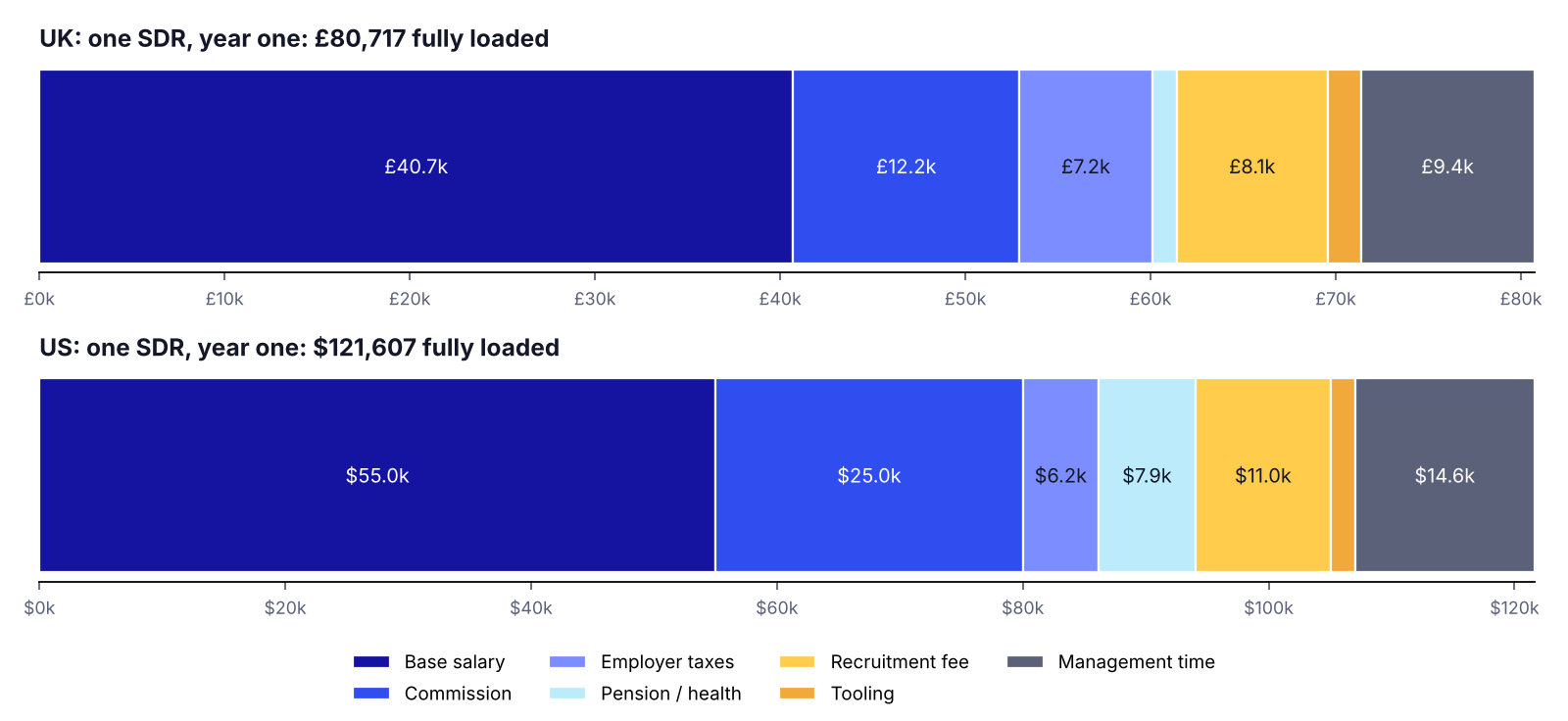
- Our worked example puts one UK SDR at about £80,700 in year one and one US SDR at about $121,600.
- At eight meetings a month, that is roughly £989 or $1,490 per booked meeting in year one.
- An AI SDR removes ramp, commission, employer taxes and recruitment fees, but it still has usage costs and needs human review.
- Most teams end up with a hybrid: software for repeatable volume, people for judgment and meetings.
Why most AI SDR vs human SDR comparisons get the maths wrong
Most comparisons put a software subscription next to a base salary and call it a day. That flatters the software and undervalues the person, because a base salary leaves out a large share of what a rep really costs.
A fair comparison uses fully loaded cost on both sides and measures the same output: meetings held, not activity logged.
What does it cost to hire an SDR? Every line item
Here is everything that goes into the cost of a hired SDR, with typical ranges for both markets.
Base salary and commission
Salary data varies by source. Glassdoor's UK data puts the average SDR base at around £40,700, while PayScale/Salary) reports about £29,500, reflecting a wider mix of entry-level roles outside London. In the US, the Bridge Group's SDR research reports a median on-target earnings (OTE) of $80,000, split $55,000 base and $25,000 variable. Location, sector and seniority move all of these numbers a long way.
Employer costs in the UK: National Insurance and pension
From April 2025, and unchanged for 2026/27, employer National Insurance is 15% on earnings above the secondary threshold of £5,000 a year, according to gov.uk's rates and thresholds for employers. On a £40,700 base alone, that is about £5,355 a year, before commission is added to the earnings it is calculated on.
Workplace pensions add another layer. Employers must contribute at least 3% of qualifying earnings, which for 2026/27 are earnings between £6,240 and £50,270, per The Pensions Regulator. On the same £40,700 salary, that is about £1,034 a year. Add both lines and you are past £47,000 before commission, a laptop or a single hour of management time.
Employer costs in the US: payroll taxes and health insurance
US employers pay 6.2% Social Security and 1.45% Medicare on wages, a combined 7.65% (IRS Topic 751), plus federal unemployment tax of up to $42 per employee and state unemployment tax, which varies by state. Health cover is usually the biggest benefit cost: the KFF 2025 Employer Health Benefits Survey puts the average single-coverage premium at $9,325, with workers paying $1,440, leaving about $7,885 for the employer. Across private industry, benefits make up 31.5% of total compensation for full-time workers, according to the Bureau of Labor Statistics.
Recruitment, tooling and management time
An agency fee of 15% to 25% of first-year base is common, and internal recruiting time is not free either. Each rep also needs seats for the CRM, sequencer, data and dialler. The most overlooked cost is management: coaching, one-to-ones, pipeline reviews and call listening typically take three to six hours of a manager's week. If you want to see where your own team's hours go, try the sales time audit.
Worked example: the fully loaded cost of one SDR in year one
Numbers are easier to trust when you can follow the arithmetic. Here is one SDR in each market, using the figures above. Management time is costed at four hours a week: £45 an hour in the UK and $70 an hour in the US (based on the Bridge Group's $146,000 median SDR manager OTE).
The US figure excludes state unemployment tax and any 401(k) match, so for many employers it is a conservative estimate. With PayScale's lower UK salary, the total drops, but employer costs, management time and ramp still add a similar share on top.
Ramp and attrition: the output nobody puts in the spreadsheet
A cost model that stops at salary misses the part that decides whether hiring pays off: how much output you get, and for how long.
Ramp is the first tax. The Bridge Group puts average SDR ramp time at 3.0 months. Month one is mostly training, and output builds from there. In our model, the first three months average 40% of full output. At a target of eight meetings a month, that gives 10.2 effective months and 81.6 meetings in year one, against 96 in a full year.
Attrition is the second tax. Average SDR tenure is 1.9 years in the same research, and 58% of companies report tenure of 12 to 23 months. When a rep leaves, you pay recruitment and ramp again, and the replacement needs their own three months before meetings flow. The role is widely treated as a stepping stone, which is good for careers and expensive for budgets. Our article on helping SDRs sell more covers ways to get more from the people you do hire.
Cost per meeting: the only fair comparison
Divide fully loaded cost by meetings, and the hire becomes comparable with software.
Two cautions. First, these figures are per meeting booked. A no-show costs the same as a meeting that happens, so measure per meeting held once you have the data. Second, the eight-meetings-a-month target is an assumption. Change it to your team's real number and the result moves, sometimes sharply.
What an AI SDR costs instead
AI SDR pricing usually follows one of three models: per seat, per contact or credit used, or per meeting booked. Whatever the model, the cost has a different shape from a salary:
- No ramp in the same sense. A workspace can be connected, a market described and a first campaign drafted within days. A person still reviews early output, but week-one output looks much closer to week twelve than it does for a new hire.
- No commission, employer taxes, pension, health cover or recruitment fee, because none of them apply to software.
- Usage costs that scale with volume. Seats, contact data and the sending infrastructure a domain needs (mailboxes, warm-up and suppression). With Ariel, you are only charged for a newly found email or phone number, and emails are verified before they are charged.
- Review time. Someone still has to approve drafts, own the strategy and take the calls that matter. Count those hours on the software side of the comparison.
A simple break-even test: add the software cost to the cost of the review time, and divide by the meetings it produces. If the result is below your fully loaded cost per meeting (for example, £989 or $1,490 in year one), software is the cheaper way to produce that pipeline.
Where hiring a human SDR still wins
None of this means software wins every time, and a page that pretended otherwise would not survive a second reading from a sales leader who has run a team.
- Complex enterprise selling. When a deal needs someone to navigate three stakeholders and hold a relationship over a nine-month cycle, that takes judgment under pressure. Software opens the door. It does not close a seven-figure deal.
- A brand-new category. If nobody has a name for the problem you solve yet, the first hundred conversations are market research. A skilled person notices the phrase prospects keep using and feeds it back into the pitch on the same call.
- Founder-led selling. Early customers often buy because the founder is on the call. No software replaces that credibility with your first 30 logos. Our guide on how SaaS founders build pipeline without SDRs covers this stage.
Where an AI SDR wins outright
- Volume and consistency. Working a defined ICP at a steady pace, week after week, without a bad Monday or a two-week holiday. Signal watchlists can recheck target accounts every six hours whether anyone is at their desk or not.
- Well-defined, repeatable segments. Once your messaging has proven itself, consistent execution matters more than rewriting the fortieth email of the week from scratch.
- Coverage across a long-tail market. One SDR can realistically keep a few hundred accounts in their head. Software can track buying signals across thousands and flag the ones worth acting on this week.
The hybrid SDR model most teams end up running
Few teams that have tried both choose one side outright. The pattern that keeps recurring looks like this:
That split changes what an SDR hire is for. Instead of paying someone to build lists and send the fourth follow-up, they spend their time on the accounts software flags and on the calls where a human voice changes the outcome. The role gets smaller in headcount and richer in the work that was always worth a salary. For more on blending channels and people, see our multichannel outreach strategy guide.
How to run your own numbers
- Enter your real salary band. Use base and commission from your own offer letters, not a national average.
- Add the costs nobody budgets for. Employer taxes, pension or health cover, recruitment, tooling and management hours.
- Compare per meeting held. Not per meeting booked, and not per email sent.
You can do this in a spreadsheet or with our ROI calculator. Either way, be clear about what the model cannot tell you: whether your market responds better to a person or a well-written email, the value a strong SDR adds beyond meetings (account knowledge, relationships, future leadership), or how your own benefits package differs from these defaults. Treat the result as the start of a conversation with finance, not a verdict.
Frequently asked questions
Is an AI SDR cheaper than hiring an SDR?
Often, for repeatable outbound, but not automatically. A hired SDR costs far more than their salary once employer costs, recruitment, tooling, management time and ramp are included. Software has no ramp, commission or recruitment fee, but it carries usage costs and needs someone to review its output. Compare both on cost per meeting held using your own numbers.
What is the fully loaded cost of an SDR in the UK?
On a £40,700 base with 30% commission, adding employer National Insurance, the minimum pension contribution, a recruitment fee, tooling and four hours a week of management time gives about £80,700 in year one and £72,600 a year after that.
What is the fully loaded cost of an SDR in the US?
On the Bridge Group median OTE of $80,000, adding employer payroll taxes, an employer health insurance contribution, a recruitment fee, tooling and management time gives roughly $121,600 in year one, before state unemployment tax or a 401(k) match.
How long does it take a new SDR to ramp?
The Bridge Group puts average SDR ramp time at 3.0 months in its 2025 research. The first month is often close to pure training, and output builds over the following two.
How long do SDRs usually stay?
Average SDR tenure was 1.9 years in the Bridge Group's 2025 data, with 58% of companies reporting average tenure of 12 to 23 months. Each departure means paying recruitment and ramp costs again.
Does an AI SDR replace the need for an SDR entirely?
No. Most teams settle on a hybrid model: software runs the repeatable top-of-funnel work, while a person owns complex accounts, handles every meeting and makes the judgment calls a list cannot make.
How much does Ariel cost?
Ariel's pricing depends on how many contacts you work and how many inboxes you run, so we share it on a call rather than quoting a single figure that would be wrong for most teams. Book a demo to get a number based on your own usage.