
.png)
Prefer listening?
Hear the audio version of this article here:
Most outbound fails for one simple reason: it shows up at the wrong time.
Teams obsess over copy, personalization tokens, and AI-written openers, while ignoring the one thing that actually determines response rates: buying windows.
Buyers don’t wake up one day and decide to care about your product.
They care when something changes, i.e., when a team starts hiring, when funding lands, when a tool breaks, or when growth pressure exposes gaps in their current setup.
Those moments leave signals.
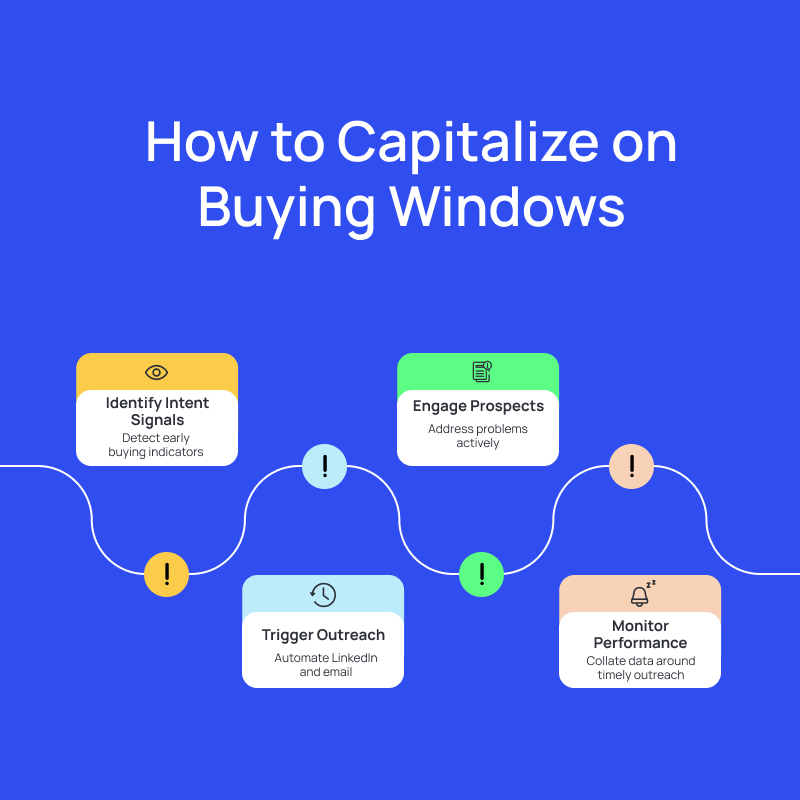
Here, we’ll break down the intent signals that matter for outbound, how to spot buying windows, and how to act on them before they close.
Let’s dive in.
Why Intent Signals Matter More Than “Personalization”
Personalization is often mistaken for relevance, but they’re not the same thing.
Referencing a prospect’s LinkedIn post, recent podcast appearance, or company news shows effort. But effort alone doesn’t move deals forward. What buyers subconsciously ask when they open an outbound message is:
“Why is this relevant to me right now?”
If there’s no clear answer, even well-written emails get ignored.
Intent signals provide that answer because they point to change. And in B2B, buying decisions almost always follow change.
When something shifts inside a company, headcount, budget, tooling, and expectations, it creates friction. That friction creates urgency.
Strong intent signals usually indicate one of three things:
- A new problem has surfaced
- An existing process is breaking under pressure
- A team is being asked to move faster with the same resources
That’s why intent-driven outbound consistently outperforms generic personalization. You’re not just showing that you noticed the prospect, you’re showing that you understand what they’re likely dealing with.
It’s not theoretical either. More than 80% of teams using intent data report measurable improvements in their outbound performance, from higher response rates to better conversion downstream.
It’s almost like, without intent, outbound is guesswork. With intent, it’s timing.
What Is a “Buying Window” in Outbound?
A buying window is the short period after a change occurs, when a company is most receptive to new solutions.
Most B2B buyers are already deep into research before they ever talk to sales. By the time outbound reaches them, the buying window is often already opening or closing.
During this window, teams are:
- Actively feeling a problem rather than abstractly acknowledging it
- Comparing options, even if informally
- More tolerant of sales conversations because they’re already seeking clarity
These windows don’t stay open for long. In most cases, they last 30-90 days. Once the initial pressure fades or a workaround is put in place, urgency drops, even if the underlying problem still exists.
This is why outbound often feels inconsistent. The same message can convert extremely well one month and fall flat the next, simply because the buying window closed.
Intent signals help you identify these moments early, while the problem is still top of mind and before the prospect has mentally deprioritized it.
Acting on buying windows manually is where most teams struggle. Salesflow helps teams trigger LinkedIn and email outreach the moment intent signals appear. Sign up for our 7-day free trial here and explore how.
3. The 4 High-Signal Intent Triggers That Actually Convert
Not all intent signals are created equal.
Some signals look impressive in a dashboard but rarely translate into real buying conversations. The signals that convert consistently share one thing in common: they’re tied to operational pressure, not passive interest.
The four signals below show up again and again in high-performing outbound programs because they indicate a company is actively dealing with change, and change creates buying windows.
1. Hiring Signals: When Growth Starts to Strain Systems
Hiring is one of the clearest indicators that something isn’t scaling.
Companies don’t add headcount unless:
- Pipeline expectations have increased
- Existing processes are breaking under volume
- Leadership wants results faster than the current setup allows
In other words, hiring often happens after a problem becomes visible, not before.
What makes hiring a strong intent signal
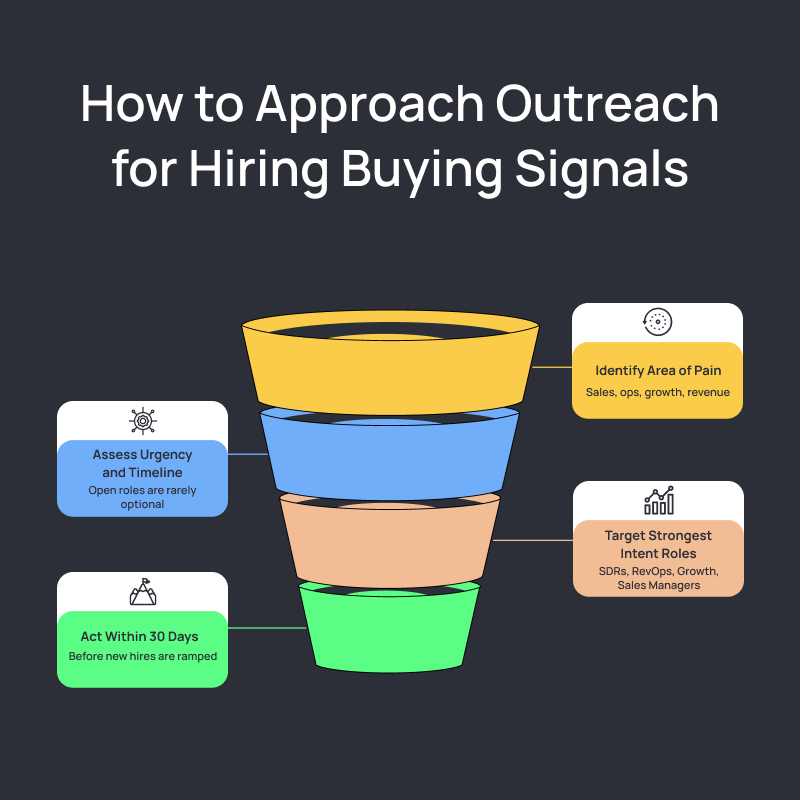
Hiring signals are especially powerful because they reveal:
- The area of pain (sales, ops, growth, revenue)
- The urgency (open roles are rarely optional)
- The timeline (pressure usually starts immediately)
Roles that indicate the strongest intent
- SDRs / BDRs → outbound volume or coverage issues
- RevOps → workflow, tooling, or reporting friction
- Growth / Demand Gen → need for predictable pipeline
- Sales Managers → coordination and execution gaps
Best timing
The buying window is strongest within 30 days of the job posting going live, before new hires are fully ramped and problems are “patched” with headcount.
Outbound angle
Position your message around supporting scale, not replacing people.
Sample templates:
Template 1:
Subject: Supporting new SDRs at {{company}}
Saw you’re hiring a few SDRs right now.
Teams usually hit this stage when outbound volume starts outgrowing the systems behind it.
Curious how you’re planning to support ramp without adding more manual work for reps.
Template 2:
Subject: Scaling outreach as the team grows
Noticed you’re adding to the sales team at {{company}}.
When teams scale headcount quickly, outreach quality and coordination often take a hit.
Happy to share how other teams avoid that during growth phases.
2. Funding Signals: When Budget Meets Pressure
Funding doesn’t just unlock budget; it creates accountability.
After a round closes, teams are expected to:
- Increase pipeline quickly
- Prove ROI on spend
- Move faster without operational chaos
This makes funding one of the most reliable intent signals in outbound.
Why funding works so well
Funding signals combine:
- Ability to buy (budget)
- Motivation to buy (expectations)
- Openness to change (systems are being reevaluated)
Best timing
Avoid reaching out immediately. The strongest window is 2-6 weeks post-announcement, once strategic priorities are being defined.
Outbound angle
Growth without excessive hiring or tool sprawl.
Sample template
Template 1
Subject: Pipeline growth post-funding
Congrats on the recent raise.
A lot of teams use this phase to increase pipeline before increasing headcount.
How are you thinking about scaling outbound over the next few months?
Template 2
Subject: Turning funding into pipeline
Saw the {{round}} announcement, congrats.
We usually see teams here looking for faster pipeline experiments without committing to long-term hires.
Worth a quick chat to compare notes?
3. Tech Install or Tech Change Signals: When Evaluation Is Already Happening
When a company changes tools, they’ve already crossed an important mental barrier: they’re open to new solutions.
Tech changes usually mean:
- Existing workflows weren’t working
- New gaps are forming
- Teams are adapting in real time
This creates a strong buying window, especially for tools that sit adjacent to their stack.
High-intent tech changes
- CRM migrations
- Sales engagement platforms
- Data enrichment or automation tools
Why this signal converts
You’re not introducing a new idea; you’re helping them solve a problem their recent change created.
Outbound angle
Acknowledge the change and highlight the gap it often exposes.
Sample template
Template 1
Subject: {{tool}} rollout at {{company}}
Noticed you recently rolled out {{tool}}.
Teams often find that new systems expose gaps in how outbound is actually executed.
Curious how that transition is going so far.
Template 2
Subject: Question on your outbound setup
Saw you started using {{tool}} recently.
Outreach tends to get more complex once new tools enter the stack.
Open to swapping notes on what’s working and what isn’t yet?
4. Leadership Changes: When New Owners Reevaluate Everything
Leadership changes, especially in revenue and operations roles, create some of the strongest buying windows in B2B.
When a new CRO, VP of Sales, or Head of RevOps joins, they’re not there to maintain the status quo. They’re hired to diagnose what’s broken, decide what stays, and deliver results fast.
Why leadership changes convert so well
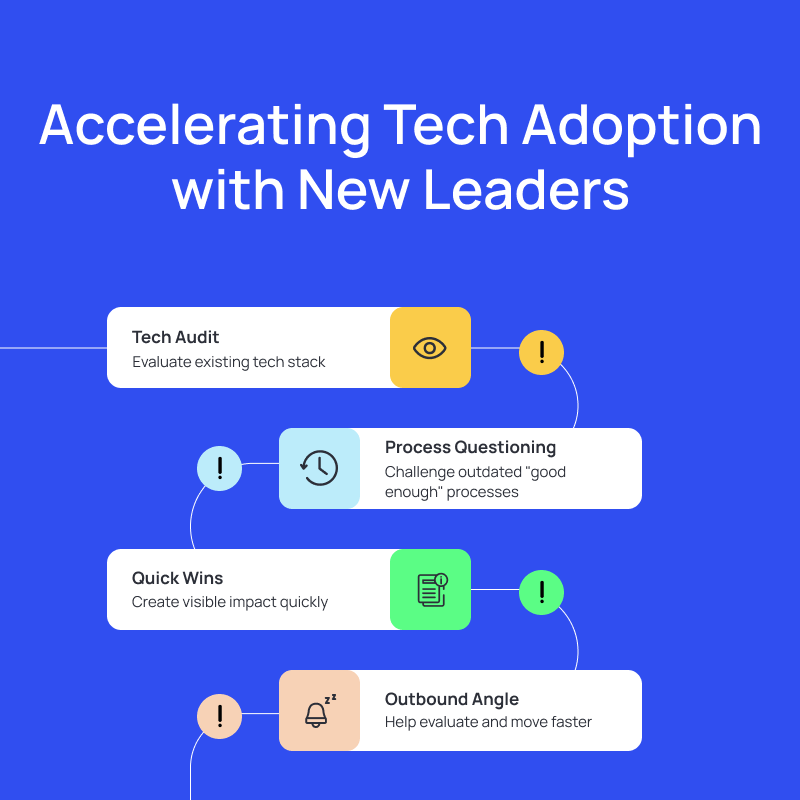
New leaders typically:
- Audit the existing tech stack within their first 30-60 days
- Question processes that were “good enough” before
- Look for quick wins that create visible impact
They’re also less emotionally attached to legacy tools, which lowers resistance to change.
Roles that signal the strongest intent
- Chief Revenue Officer (CRO)
- VP of Sales
- Head of Revenue Operations / RevOps
These roles directly own pipeline performance and execution efficiency, making them ideal buyers for outbound, workflow, and GTM tooling.
Best timing
The buying window is strongest 30-90 days after the leader joins, once they’ve identified gaps but before long-term decisions are locked in.
Outbound angle
Position your message around helping them evaluate and move faster, not replacing what their predecessor chose.
Sample template
Template 1
Subject: First 90 days at {{company}}
Congrats on the new role at {{company}}.
Most leaders use the first few months to review pipeline generation and execution bottlenecks.
Curious what’s on your evaluation list right now.
Template 2
Subject: Supporting early wins in a new role
Saw you recently stepped into the {{role}} role.
New leaders often look for quick wins before longer-term changes take shape.
Happy to share what we’ve seen work well in similar transitions.
How to Operationalize Intent Signals
Intent signals are only powerful if they’re turned into systems. Without structure, they quickly become noise: too many triggers, too many exceptions, and no clear execution path.
The goal isn’t to track every signal. It’s to build a repeatable outbound engine that reacts quickly when the right kind of change happens.
A simple, workable intent workflow
1. Track only 2–3 intent signals at a time
Trying to monitor everything leads to shallow execution. Pick the signals that align most closely with your ICP and buying motion, and ignore the rest.
To facilitate quick outreach, you need instant data. Our blog on setting up Google Alerts for targeted outreach is a good read if you want to learn how to do just that.
2. Assign one clear outbound angle per signal
Each intent signal should answer a single question: “Why are we reaching out now?”
If the message can’t be explained in one sentence, the signal is too vague.
This keeps messaging focused and prevents generic “catch-all” sequences.
3. Build dedicated sequences per signal
Intent signals lose power when they’re blended together.
A funding-triggered message should not sit in the same sequence as a hiring-triggered one. Each signal represents a different type of pressure, and deserves its own framing.
Dedicated sequences also make it easier to measure what’s actually working.
4. Run time-bound campaigns (30-45 days)
Intent decays. Fast.
Running intent-based outbound indefinitely defeats the purpose. Time-bound campaigns force urgency and keep your system aligned with buying windows instead of stale triggers.
If you’re already tracking intent but finding it hard to operationalize across LinkedIn and email, this is exactly what Salesflow was built for. Explore intent-based outbound workflows in Salesflow, sign up for our 7-day free trial here.
Common mistakes to avoid
Mixing multiple intent signals in one campaign: When everything is “intent-based,” nothing is. Buyers feel the mismatch immediately.
Over-personalizing instead of acting fast: Intent-based outbound rewards speed more than polish. A timely, clear message will outperform a perfectly personalized one that arrives two weeks late.
Ultimately, Intent Is About Timing, Not Tricks
Outbound doesn’t fail because buyers hate being contacted. It fails because most outreach arrives when nothing has changed on the buyer’s side.
Buying decisions are almost always triggered by timing, by moments when teams feel pressure, re-evaluate systems, or are forced to move faster than their current setup allows.
Intent signals help you align outbound with those moments.
Teams that consistently act on intent don’t just see incremental gains; many see 2x or higher conversion rates simply by engaging when buying windows are open.
The best outbound teams aren’t sending more messages or chasing every signal they can find. They’re disciplined about when to engage, clear about why they’re reaching out, and fast enough to act while the buying windows are still open.
That’s where execution matters.
Teams that consistently win at outbound don’t just notice intent, they operationalize it. They trigger the right outreach, across LinkedIn and email, at the moment buying windows open, without relying on brittle workflows or manual follow-ups.
If you want to move from tracking intent to acting on it, Salesflow is built to help teams do exactly that, turning real intent signals into timely, multichannel outbound that converts.
👉 Start your free trial and see what better timing does for your outbound.
FAQs:
.svg)
.png)


.png)