

Prefer listening?
Hear the audio version of this article here:
Referrals are the lifeblood of most agencies. In fact, referrals account for 34% of how clients discover agencies.
However, referrals are also the ceiling.
That's because it's a comfortable place to be until a key client churns, a referral source goes quiet, or the market gets competitive enough that warm intros alone don't fill the gap.
The agencies growing on demand aren't waiting for introductions. They're running structured outbound: targeted, multi-channel, and systematic. They treat new business development the same way their clients treat lead generation, as a process with inputs, outputs, and levers to pull.
This guide covers how to build that process from scratch: how to position the offer, define the right targets, write outreach that lands, and execute a sequence that books meetings without burning the brand.
The Agency Outbound Problem (And Why Most Get It Wrong)
Agency outbound has a reputation problem, mostly because most agencies do it badly.
The typical agency cold email leads with credentials: "We're a full-service digital agency with 10 years of experience and clients across 12 industries." Then a list of services. Then a vague ask to "hop on a call."
Decision-makers at prospective clients see versions of this message constantly. They've become immune to it.
The failure isn't outbound as a channel. It's positioning as an afterthought. Agencies that win through outbound lead with a specific problem they solve for a specific type of client, not a portfolio and a pitch.
That's the shift this guide is about.
Step 1: Nail the Positioning Before Any Outreach Goes Out
The most common reason agency outbound fails isn't a bad subject line. It's a generic offer.
"Full-service digital agency" is not a positioning. It's a description. And descriptions don't make anyone pick up the phone.
Specificity is what makes outreach land. A message that says "we help Series B SaaS companies reduce CAC through paid search and conversion-rate optimization" is nine times more compelling to the right person than "we run paid ads for B2B companies." Same service, completely different signal.
Before writing a single outreach message, get clear on:
- The specific type of client: industry, stage, size, business model
- The specific problem they feel acutely right now
- The outcome delivered, in language the client uses, not agency jargon
- Why this agency is better placed to solve it than anyone else
Vertical specialization is the biggest unlock most agencies ignore. 88% of agency owners believe that specializing in a specific industry vertical can positively impact their client acquisition rate. And yet most agencies still position themselves as generalists because it feels safer. The irony is that the generalist position is actually the riskier one: it creates more competition, longer sales cycles, and weaker conversion rates on every outreach campaign.
Choosing a vertical doesn't mean turning away business outside it. It means leading with a clear identity that makes the right prospects immediately recognize themselves.
Step 2: Define the ICP With Buying-Intent Precision
Who is the right client? Not "any company that needs marketing." That's the whole market. The question is: who is most likely to buy, buy quickly, and see results fast enough to become a long-term retainer?
A useful agency ICP includes:
- Industry or vertical (e.g., B2B SaaS, e-commerce, fintech, professional services)
- Company size or stage (e.g., Series A, 50-200 employees, $5M-$50M revenue)
- Current problem signal: scaling a new market, launching a product, just brought on a new marketing leader
- Current vendor situation: no agency, unhappy with their current one, or just ended a contract
- Decision-maker profile: who actually controls the budget (often the CMO, VP Marketing, or founder at smaller companies)
Trigger events matter more than firmographics. A 100-person SaaS company is not inherently a good target. A 100-person SaaS company that just closed a Series B, hired a new VP Marketing, and posted three open roles in growth? That's a company with budget, mandate, and urgency. Same firmographics. Completely different timing.
- Funding announcements (new round = new budget cycles)
- New marketing or growth hire (new leader = new vendor decisions)
- Job postings in areas the agency covers (signal of internal gaps)
- Content or activity suggesting a growth push (product launches, new market entry)
Map who to reach inside the account. Most agencies target one person: the CMO or the founder. But larger deals often involve more stakeholders. The marketing lead champions the relationship, the CFO approves the budget, and legal or procurement can block or slow the deal. Knowing who's in the room prevents deals from stalling after a strong first call.
Here’s a quick cheatsheet you can use to map your ICP.
For ICP:

For Buying Committee Members:

Step 3: LinkedIn + Email Is the Right Stack for Agency Outbound
Cold calling has limited utility for agency new business. Decision-makers at the companies agencies typically target, founders, CMOs, VP Marketing, are rarely available by phone and rarely responsive to unsolicited calls. The stack that works is LinkedIn and email, run together as a coordinated sequence.
Why this combination works for agencies:
Prospective clients will check an agency's LinkedIn presence before responding to any outreach. The company page, the founder's profile, recent posts, case study content: all of it functions as a trust layer. A well-maintained LinkedIn presence converts an outreach message from "cold contact" to "someone I've seen around."
Email handles the pitch itself. A slightly longer message with a specific hook, a relevant case study or outcome, and a clear, low-friction ask converts better than a LinkedIn DM for higher-ticket agency deals.
Together, the channels reinforce each other. A prospect who sees a LinkedIn connection request from an agency founder, reviews the profile, then receives a well-targeted email the next day is in a fundamentally different mental state than someone who receives a cold email out of nowhere.
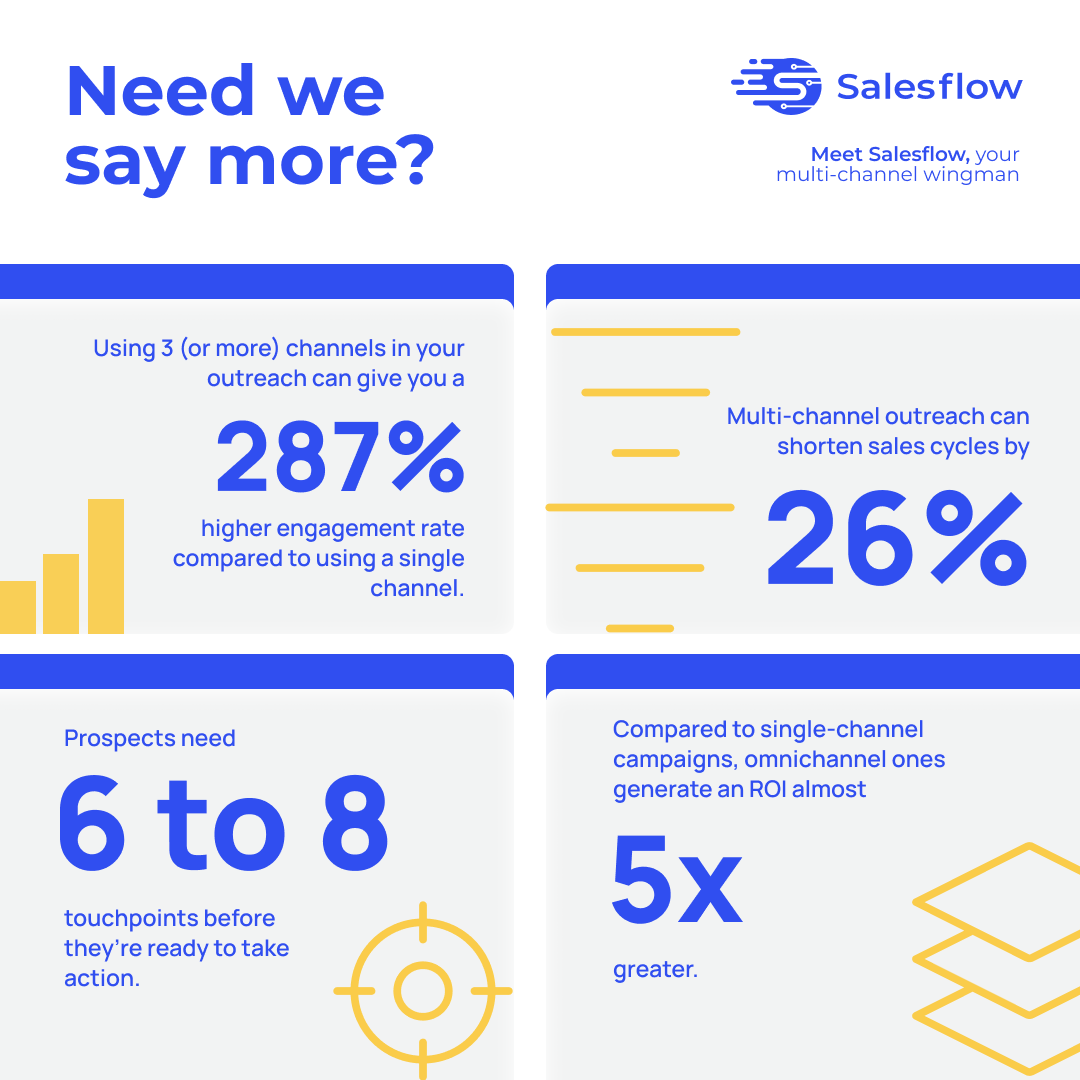
Email-only campaigns are generating almost 30% fewer leads year-on-year. Multi-channel isn't optional for agencies in 2026. It's the baseline.
Want to run LinkedIn + email sequences for your agency's new business pipeline without the manual work? Watch it in action here:
Start your first campaign with Salesflow and automate your outbound from day one. Sign up for a 7-day free trial here.
Channel priority by decision-maker type:
- Founders and CEOs at SMBs: LinkedIn first. They're highly active, post regularly, and respond well to relevant peer-level connection requests from other founders.
- CMOs and VPs of Marketing: Email first, LinkedIn follow-up. Senior marketing leaders get a lot of LinkedIn noise. A well-targeted email often lands better as the first touch.
- Growth and demand gen leads: Both simultaneously. This persona lives across both channels and tends to respond to channel variety.
Step 4: Write Outreach That Reads Like Research, Not a Pitch
The single biggest mistake agencies make in outreach is leading with the agency. The prospect doesn't care about the agency yet. They care about their problem.
The message that books a meeting is the one that demonstrates: you know what they're dealing with, you've solved it before, and talking to you is worth 20 minutes of their time.
The Agency Cold Email Structure
- Specific hook: something true about them right now, not a generic opener
- Relevant proof: a result or case study that maps to their situation
- Simple ask: a specific, low-friction next step
In practice:
"Noticed [Company] just hired a new VP of Demand Gen and opened two SDR roles. Usually when that happens, paid acquisition and outbound are getting a serious look.
We help B2B SaaS companies at this stage build coordinated LinkedIn and email acquisition programs that reduce CPL by 30-40% versus single-channel approaches. Did it for [Similar Company] during their Series B hiring push.
Worth 20 minutes to see if the timing's right?"
No credentials upfront. No service list. A hook, a result, an ask.
LinkedIn Connection Notes
300 characters. The goal is to earn the connection, not start the pitch.
"Noticed [Company] is scaling the marketing team, we work with a lot of [industry] companies at this stage. Thought it was worth connecting."
Once connected, the first message is a question, not a follow-up pitch. A conversation is the goal. The pitch comes later.
The Follow-Up Sequence
Agency deals are longer-cycle than SaaS. The decision-maker is often busy, protective of their time, and considering multiple options. Most replies come after the third or fourth touch. Stopping after one is where most agency new business efforts fall apart.
A 5-step sequence across 16-20 days:
Each follow-up should add something: a new case study, a relevant piece of data, a question tied to something they've posted. Follow-ups that just say "bumping this up" burn goodwill fast. Follow-ups that add value earn responses.
Writing the messages is the easy part. Executing them consistently across 200 prospects without dropping the ball is where most agencies lose the plot. Use Salesflow to automate your agency's outbound without losing the personal touch. Start your 7-day free trial here.
Step 5: Build the Stack (Without Hiring a Business Development Team)
Four tools are enough for an agency to run a serious outbound motion without a dedicated new business hire. Here's how to build the perfect sales tech stack in 2026:
1. Prospect data: LinkedIn Sales Navigator for finding the right decision-makers by industry, company size, and seniority. Apollo.io for verified email addresses and supplementary contact data. Clay for enriching prospect lists with trigger signals, especially useful once volume increases.
2. Multi-channel outreach automation: This is where Salesflow comes in. Running LinkedIn and email sequences manually across 100+ prospects is unsustainable past the first two weeks. Salesflow lets agencies build coordinated LinkedIn and email campaigns in a single workflow: connection requests, follow-up messages, and emails all sequenced intelligently based on what the prospect actually does. When a prospect replies, the sequence pauses automatically so no one gets a follow-up after they've already responded.
For agencies running outbound across multiple clients, Salesflow's team management features let multiple LinkedIn accounts and email inboxes run from a single dashboard, with separate campaigns per account and centralised reporting.
3. Case study and proof assets: Outreach without proof is just noise. Before launching any campaign, have at least one specific, outcome-focused case study that maps to the target ICP. "We helped [Company Type] achieve [Result] in [Timeframe]" is the format that works. Vague social proof ("we work with leading brands") doesn't convert.
4. CRM: HubSpot's free tier handles pipeline tracking at this stage. The goal isn't a complex 14-stage pipeline: it's logging what happened, what stage each conversation is at, and when to follow up. Salesflow's native HubSpot integration and two-way Zapier connection keep outreach data and CRM records in sync without manual entry.
Step 6: The 90-Day New Business Playbook for Agencies
Weeks 1-2: Foundation
- Write the positioning statement in one paragraph: who it's for, what problem it solves, what outcome it delivers
- Build first prospect list: 150-250 contacts that match the ICP tightly
- Write messaging v1: two email variants (different hooks), two LinkedIn templates, one case study proof point per email (Use our A/B message testing sheet)
- Set up Salesflow: LinkedIn + email sequence, 5 steps over 16-20 days
- Review every message out loud. If it sounds like AI, rewrite it
Weeks 3-4: First Campaign Live
- Launch to the first 75-100 prospects
- Track: LinkedIn connection acceptance rate, email reply rate, positive vs. negative reply split
- The most important metric at this stage is replies, including negative ones. They're data.
- Note which hooks generate responses and which get ignored
Weeks 5-8: Iterate on the Signal
- Rewrite messaging based on what's generating replies
- If a particular industry or company type is responding better, narrow further in that direction
- Add a second campaign with updated messaging targeting a fresh batch
- Track objection patterns: "we have someone internally" and "not the right time" require different responses
Weeks 9-12: Scale and Systematize
- Scale list size around the messaging that's working
- Add a referral ask to every discovery call that goes well: "Is there anyone in your network in a similar situation who might find this useful?" is a genuinely effective close to a good first conversation
- For high-priority target accounts, layer in a light ABM approach: engage with their LinkedIn content before outreach begins, so the connection request arrives with some prior familiarity
On Lead Quality
Meetings with the wrong type of client are worse than no meetings. An agency that books 20 discovery calls with companies that are too small, have no budget, or are looking for a one-time project rather than a retainer has wasted more time than one that booked 8 well-qualified calls.
Build a qualification layer early: ask about current marketing investment, internal team structure, and growth goals in the first message exchange before pushing for a call. It saves everyone's time.
Common Mistakes That Kill Agency Outbound
Pitching services instead of solving problems. Prospects don't buy "content marketing retainers." They buy growth, lead generation, or category authority. Frame every message around the outcome, not the deliverable.
Using the same sequence for every prospect. A CMO at a 500-person company and a marketing manager at a 30-person startup are completely different buyers with different motivations, different budgets, and different decision-making processes. One sequence doesn't work for both.
Leading with the agency's awards and credentials. Nobody books a meeting because an agency won a regional marketing award. Lead with the prospect's situation, not the agency's history.
Treating outbound and content as separate strategies. The agencies that convert outreach at the highest rate also have a strong LinkedIn presence. When a prospect checks the profile after receiving the email, and finds good content, case studies, and a clear point of view, conversion goes up significantly. Outbound and content amplify each other.
Stopping outreach when things get busy. New business development is the first thing most agencies deprioritize when delivery gets hectic. Then a client churns and the pipeline is empty. Consistency over time is what separates agencies with a predictable new business engine from those in a permanent feast-or-famine cycle.
Referrals Are a Floor, Not a Strategy
The agencies that scale predictably are the ones that treat new business development as a function, not a hope.
Referrals are valuable. They should be actively cultivated, not passively relied on. And they're most powerful when combined with a structured outbound motion that reaches the right clients before they're actively looking, positions the agency as the obvious choice for a specific type of problem, and stays consistent even when the delivery calendar is full.
LinkedIn and email, coordinated and automated through Salesflow, is the most efficient way to build that engine without adding headcount or sacrificing the quality of existing client work.
Ready to build a predictable pipeline for your agency?
FAQs:
.svg)
.png)


