
Prefer listening?
Hear the audio version of this article here:
If you’re running cold outreach at any meaningful volume, you’ve likely run into the first real hurdle most teams face when they start sending emails at scale: deliverability.
Most teams know the basics. Authenticate your domains. Warm up inboxes. Don’t blast low-quality lists.
And yet, reply rates still fluctuate. Inbox placement becomes inconsistent. Scaling outreach starts to feel riskier than it should.
In practice, strong deliverability in 2026 means consistently landing 95-99% of emails where they’re supposed to go. Anything below that range usually points to underlying issues with identity, reputation, or sending behavior, even if campaigns appear to be “working.”
That’s because deliverability isn’t about checking a few boxes anymore. It’s about how your outbound system behaves day to day: how you send, who you send to, and how consistently you do it.
This playbook is a practical guide to those mechanics.
We’ll examine the components that influence inbox placement today: infrastructure, list hygiene, and sending pace, and how they interact when you’re running cold outreach as an ongoing program.
Let’s dive in.
Infrastructure: The Foundation of Cold Outreach Deliverability
Before inbox providers evaluate engagement, copy, or sending patterns, they look at one thing first: identity.
Cold outreach lives or dies on whether inbox providers can clearly understand who is sending the email and which systems are allowed to send on their behalf. If that identity is unclear or inconsistent, every other deliverability effort starts from a weaker position.
This is why authentication isn’t optional. Google explicitly recommends configuring SPF, DKIM, and DMARC for senders who want reliable delivery to Gmail. Without them, inbox providers have limited ability to associate your outreach with a stable, trustworthy sender identity.
SPF, DKIM, and DMARC aren’t just technical hygiene; they’re trust signals. They tell inbox providers whether your outbound emails come from a sender they can reliably identify and monitor over time.
What Matters in SPF, DKIM, and DMARC
You don’t need perfect DNS configurations to earn trust, but you do need clarity and consistency.
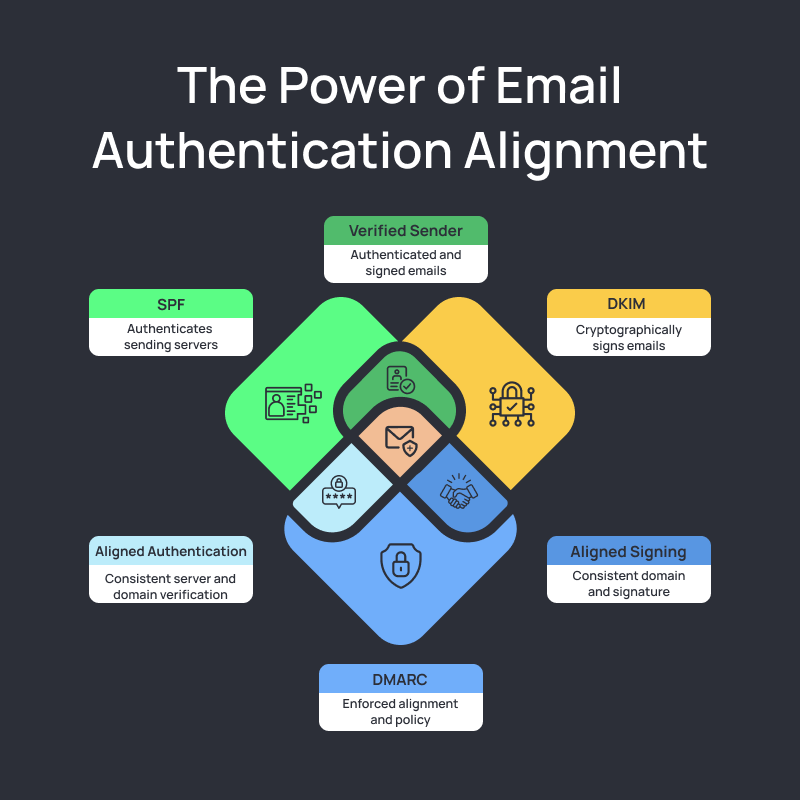
- SPF defines which servers are allowed to send email for your domain. Issues tend to arise when teams stack multiple tools and overload their SPF record with too many includes, creating ambiguity about legitimate senders.
- DKIM provides a cryptographic signature that ties each message back to your domain. What matters most here is consistency: signing emails from the same domain you’re sending from, across all inboxes.
- DMARC ties identity together through alignment. Inbox providers use it to confirm that the domain visible to recipients matches the domains authenticated by SPF or DKIM.
The key point is alignment, not enforcement. Even without strict DMARC policies, inbox providers still use alignment as a signal to assess whether a sender’s identity is stable or fragmented.
When domains don’t align, emails may still be delivered, but trust erodes as volume increases.
A Note on Unsubscribes and Complaints
Infrastructure also shapes how inbox providers interpret recipient feedback.
Spam complaints damage reputation far more than most teams expect. Making it easy to opt out, through clear unsubscribe language and proper list-unsubscribe handling, reduces the likelihood that recipients flag your emails as spam, even in cold outreach.
When opting out is difficult or unclear, friction compounds risk. Over time, that friction shows up as higher complaint rates and weaker inbox placement.
Infrastructure won’t guarantee inbox placement on its own. But without clear identity and low-friction exits, inbox providers have little reason to extend trust as you scale.
Once that foundation is in place, deliverability becomes a question of behavior: how consistently you send, who you send to, and how quickly negative signals are removed from the system.
Want to run cold outreach with clean infrastructure from day one?
Salesflow helps you launch email and LinkedIn outreach with built-in safeguards, domain alignment, and inbox-safe defaults.
Reputation: How Inbox Providers Judge You Over Time
Once your identity is clear, inbox providers shift their focus to behavior.
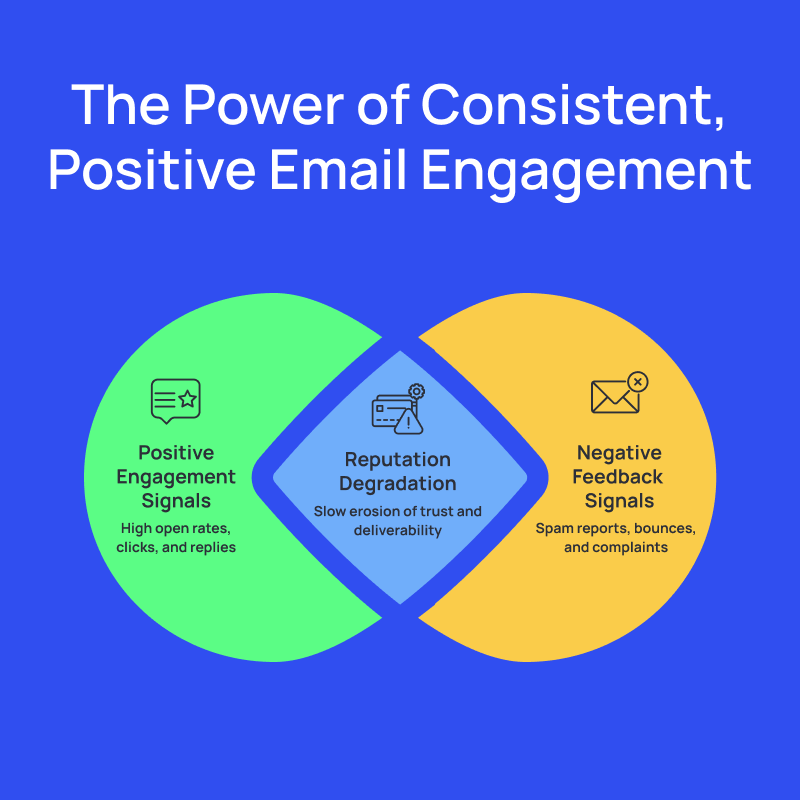
Reputation isn’t built from a single campaign or a single email. It’s built from patterns: how consistently you send, how recipients react, and how quickly negative signals show up and are corrected. This is why deliverability can look “fine” one week and feel unstable the next. Reputation is cumulative.
In practice, inbox providers care far more about engagement, complaints, and consistency than raw sending volume. High volume doesn’t hurt on its own. Erratic volume, poor targeting, and repeated negative feedback do.
What Reputation Is (In Practice)
Reputation is not a score you optimize once. It’s an ongoing assessment based on recent behavior.
Inbox providers look for signals like:
- how often recipients engage or ignore your emails
- how frequently messages are marked as spam
- whether sending patterns stay consistent over time
- how quickly bounces and complaints are removed from future sends
A single bad send won’t sink you. Repeated weak signals will.
This is why two teams can send similar volumes and see very different results. One generates predictable, low-friction engagement. The other introduces just enough negative feedback to slowly degrade trust.
Reading Gmail’s Signals
For most cold outreach teams, Gmail provides the clearest window into reputation through its sender feedback tools. The mistake teams often make is treating these signals as alerts instead of indicators.
The most important metric to watch is the spam complaint rate. It carries more weight than opens or clicks because it reflects explicit negative feedback from recipients. When complaint rates rise, inbox placement tends to degrade soon after.
At the same time, small fluctuations are normal. Day-to-day changes don’t usually mean something is broken. What matters is direction. A gradual upward trend in complaints or delivery issues is far more meaningful than a single spike.
“No data” is also a signal. It often means sending volume is inconsistent, fragmented across domains, or too risky to build a stable reputation profile. Consistency makes behavior legible to inbox providers. Inconsistency creates uncertainty.
How to Interpret Reputation Signals Correctly
The goal is to understand what inbox providers are reacting to.
When reputation weakens, the fastest improvements usually come from operational changes:
- tightening targeting rather than rewriting copy
- reducing volume temporarily instead of pushing through
- removing disengaged or risky segments sooner
Reputation improves when behavior becomes easier to predict and easier to trust.
Deliverability improves when outreach is predictable.
Salesflow helps teams manage pacing, replies, and multichannel sequences from one place, so outbound behavior stays consistent as you scale.
With identity established and reputation monitored correctly, the next variable that quietly determines deliverability is data quality: who you send to, and how quickly risk is removed. That’s where hygiene comes in.
Hygiene: Removing Risk Before it Accumulates
Even with solid infrastructure and a stable reputation, poor data will eventually surface as deliverability issues.
Inbox providers don’t know your intent. They infer it from outcomes. When emails consistently reach the wrong people, generate no engagement, or trigger negative feedback, those signals look the same as spam, regardless of how well your domains are authenticated.
Hygiene is how you prevent that risk from compounding.
Before You Send: Preventing Reputation Drag
Email verification is a baseline, not a safeguard. It reduces hard bounces, but it doesn’t tell you whether a recipient is relevant, current, or likely to engage.
What matters just as much as who you include is who you exclude.
Suppressing risky segments: role-based addresses, stale records, previous non-responders, and known complainers, removes negative signals before they’re ever generated. When that suppression doesn’t happen, inbox providers see repeated sends to recipients who never engage or actively reject the message.
At scale, poor targeting and spam look identical. The difference is only visible internally.
While Campaigns Run: Listening to Negative Signals
Bounces are easy to spot and usually handled automatically. The more useful signals are quieter.
Replies like “wrong person,” “no longer here,” or “not relevant” are early warnings that data quality or targeting assumptions are off. Ignoring those signals and continuing follow-ups adds friction without upside.
This is also where rigid sequencing does damage. A follow-up sent after a negative reply doesn’t just waste a touch; it reinforces the wrong signal. Stopping outreach when relevance is in question protects reputation more than squeezing in one more step.
After Campaigns: Why Pruning Protects Future Sends
Hygiene doesn’t end when a campaign does.
Contacts who never engage, never reply, and never opt out still contribute to future deliverability outcomes. Over time, repeatedly sending to disengaged recipients lowers the average engagement profile of your domain.
Pruning those contacts, based on time, behavior, or lack of response, keeps future campaigns healthier. Smaller, cleaner lists consistently outperform larger ones, not because they convert better, but because they preserve trust with inbox providers.
Good hygiene doesn’t increase reply rates directly. It prevents the slow erosion that makes good outreach harder to deliver in the first place.
Throttling: How Volume Decisions Shape Trust
Once your data is clean, deliverability becomes less about who you send to and more about how you send.
Inbox providers don’t evaluate volume in isolation. They evaluate change. Stable sending patterns are easy to understand and easy to trust. Erratic ones aren’t.
This is why throttling matters.
Why Sending Faster Rarely Helps
Increasing send volume is often treated as a lever for growth. In practice, it’s one of the fastest ways to introduce risk.
Inbox providers reward predictability, not efficiency. Sudden increases in volume, even when engagement is decent, look automated. They create uncertainty about whether a sender’s behavior has changed, which leads to more cautious inbox placement.
More volume also amplifies every underlying issue. Weak targeting, slow unsubscribe handling, and soft negative signals all scale with it.
Sustainable Pacing For Cold Outreach
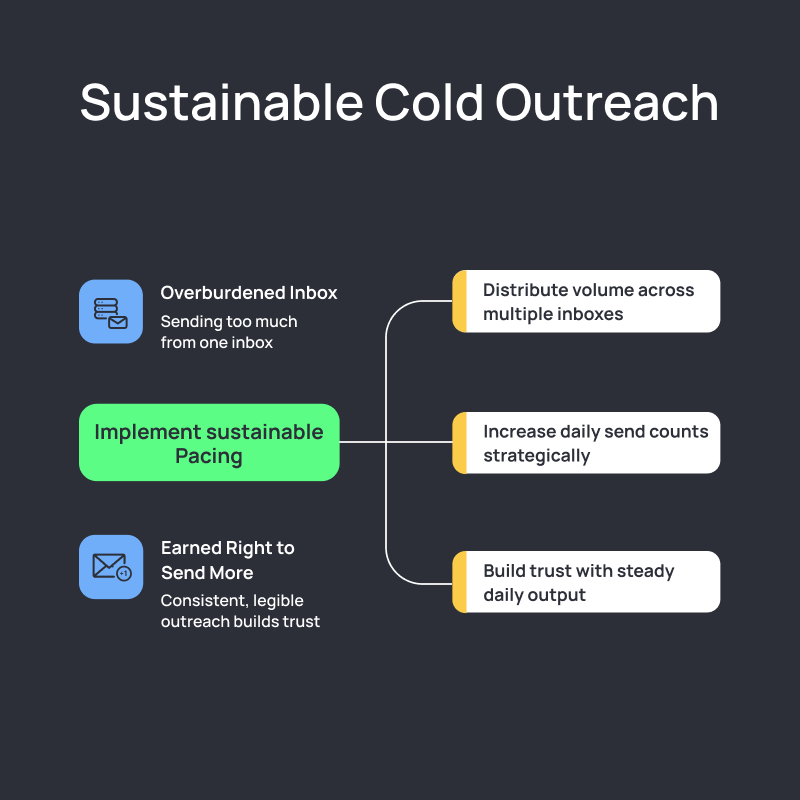
The goal of throttling isn’t to send less forever. It’s to earn the right to send more.
This is why scaling across multiple inboxes consistently outperforms pushing a single inbox harder. Spreading volume keeps individual sending patterns stable while allowing total outreach to grow.
Follow-ups also matter here. A sequence with multiple steps can double or triple daily send counts without feeling like a volume increase internally. Inbox providers see the total output, not the intent behind it.
Consistency is what keeps that output legible. A steady daily cadence builds far more trust than high-volume bursts followed by quiet periods.
Why Throttling Works
Throttling works because it reduces uncertainty.
When sending behavior changes gradually, inbox providers can confidently attribute engagement and complaints to normal variation rather than abuse. When behavior changes abruptly, they respond conservatively.
The teams that scale cold outreach successfully don’t push volume until something breaks; they increase sending only when existing patterns are stable, and signals are clean.
With identity established, reputation monitored, data kept clean, and volume paced responsibly, deliverability becomes predictable rather than fragile.
From there, the final variable is content: not what you say, but how your emails are interpreted at scale.
Content Risk: How Intent is Inferred, Not Read
Once identity, reputation, hygiene, and pacing are in place, inbox providers turn to content, not to understand meaning, but to detect patterns.
This is where many teams overcorrect. Content filters don’t read emails the way people do. They don’t look for “bad words” or clever phrasing. They look for signals that suggest automation, repetition, or low intent at scale.
Why “spam words” are the wrong mental model
The idea that certain words trigger spam filters is outdated. What matters more is structure and sameness.
Emails that share identical layouts, repeated phrasing, aggressive formatting, or heavy link usage across large volumes are easier to classify as automated outreach. Even well-written copy can become risky if it’s reused too uniformly.
In contrast, small variations in structure and intent are often enough to reduce that risk.
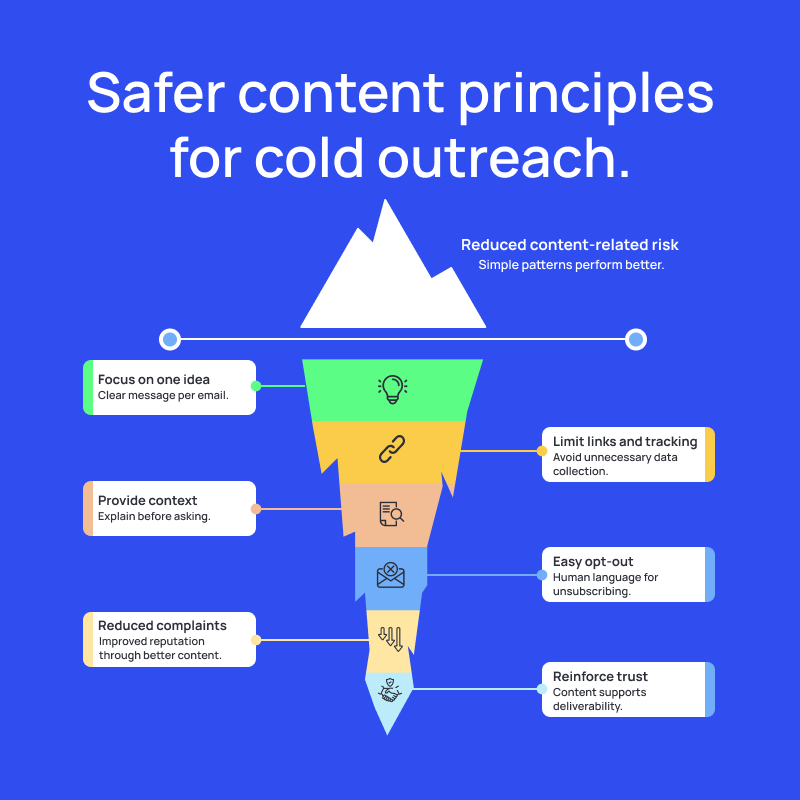
Safer content principles for 2026 cold outreach
You don’t need complex copy to reduce content-related risk. Simple patterns tend to perform better and age more gracefully.
- Focus on one clear idea per email
- Limit links and avoid unnecessary tracking
- Provide context before making an ask
- Make it easy to opt out, in human language
These choices don’t just improve engagement. They reduce complaints, which feeds directly back into reputation.
Content won’t rescue poor deliverability on its own. But when everything else is working, it can either reinforce trust or undermine it.
When Deliverability Drops: What to Fix First
Even with strong foundations, deliverability can fluctuate. When it does, the biggest mistake teams make is changing too many variables at once.
A disciplined response starts with identifying where the issue is showing up and adjusting the inputs that actually influence trust.
Gmail-only issues vs. global issues
The first question to answer is whether the drop is isolated or widespread.
If performance declines primarily in Gmail inboxes, the issue is usually reputation or pacing rather than copy. Gmail is often the most sensitive to changes in sending behavior and recipient feedback.
If deliverability drops across multiple providers at the same time, it’s more likely tied to infrastructure, list quality, or a recent change in volume or targeting.
This distinction matters because it determines how aggressive your response needs to be.
Delivered but no replies doesn’t mean a copy problem
Across cold outreach, average reply rates tend to sit around 3-4%. Top-performing teams routinely exceed 10%, but they get there by protecting deliverability first, not by rewriting copy every time replies dip.
A common misdiagnosis is assuming that lower replies automatically mean bad messaging.
If emails are being delivered but engagement falls sharply, the underlying issue is often trust, not content. Inbox providers may be placing messages in less visible folders, or recipients may be receiving them with lower priority.
Rewriting copy in this state rarely fixes the problem and can introduce new variables that make diagnosis harder.
Why cutting volume is often the fastest recovery lever
When reputation weakens, reducing volume is usually the most effective short-term correction.
Lowering send volume:
- limits additional negative signals
- stabilizes sending patterns
- gives inbox providers time to reassess behavior
This isn’t a rollback, it’s a reset of expectations. Once signals stabilize, volume can be increased again gradually.
What not to change during a dip
When deliverability drops, some changes tend to do more harm than good.
Avoid:
- switching sending domains
- rotating inboxes unnecessarily
- overhauling copy mid-dip
- changing tools without a clear cause
These moves fragment identity and make it harder for inbox providers to rebuild trust. Stability is more valuable than optimization during recovery.
Deliverability issues are rarely solved by a single tweak. They improve when behavior becomes consistent, predictable, and easy to trust again.
Scaling Without Burning Reputation
Once the fundamentals are in place, the question most teams face is the same: how do you scale outreach without putting deliverability at risk?
The answer usually isn’t more email.
Why multichannel outreach reduces email pressure
Email carries the most deliverability risk because it generates the strongest negative signals when things go wrong. Other channels don’t.
Using additional channels like LinkedIn allows teams to stay present without forcing email volume higher. It spreads outreach across touchpoints while keeping individual email sending patterns stable and predictable.
Inbox providers don’t see your broader strategy. They only see email behavior. Reducing pressure on that channel protects reputation.
Want to go multi-channel without risking your account(s)?
Salesflow offers safe, reliable, and easy-to-set-up multi-channel outreach for sales teams, agencies, SMBs, and growing startups. See how you can set up multi-channel sequences in 5 simple steps below:
Sign up for the 7-day free trial here, no card required.
Shifting touches instead of increasing send volume
Many teams try to scale by sending more emails per inbox. A more durable approach is to redistribute touches.
That might mean:
- fewer follow-ups by email
- earlier or later touches on other channels
- adjusting sequences so email supports outreach instead of carrying it
The result is the same total reach, but with fewer risky signals concentrated in one place.
Letting engagement earn a higher sending capacity
The safest way to scale email is to let engagement lead.
When existing sends show stable engagement and low complaints, inbox providers are more likely to trust incremental increases in volume. When engagement weakens, pulling back protects future capacity.
This creates a natural feedback loop: relevance earns trust, trust earns scale.
Teams that treat outbound as a system, rather than a volume race, are able to grow without constantly resetting deliverability.
At that point, inbox placement stops being a limiting factor and becomes a predictable part of the outbound engine.
Turning Deliverability Into a System
Deliverability isn’t something you configure once and move on from. It’s the result of repeated, consistent decisions.
Infrastructure gets you recognized. Hygiene keeps you trusted. Throttling protects reputation. Relevance keeps you in the inbox.
When those pieces work together, cold outreach becomes more predictable, easier to scale, and far less fragile.
If you want to run outbound as a system, not a series of experiments, sign up for Salesflow. It’s your multi-channel wingman for safe, reliable, speedy outreach.
FAQs:
.svg)
.png)


.png)