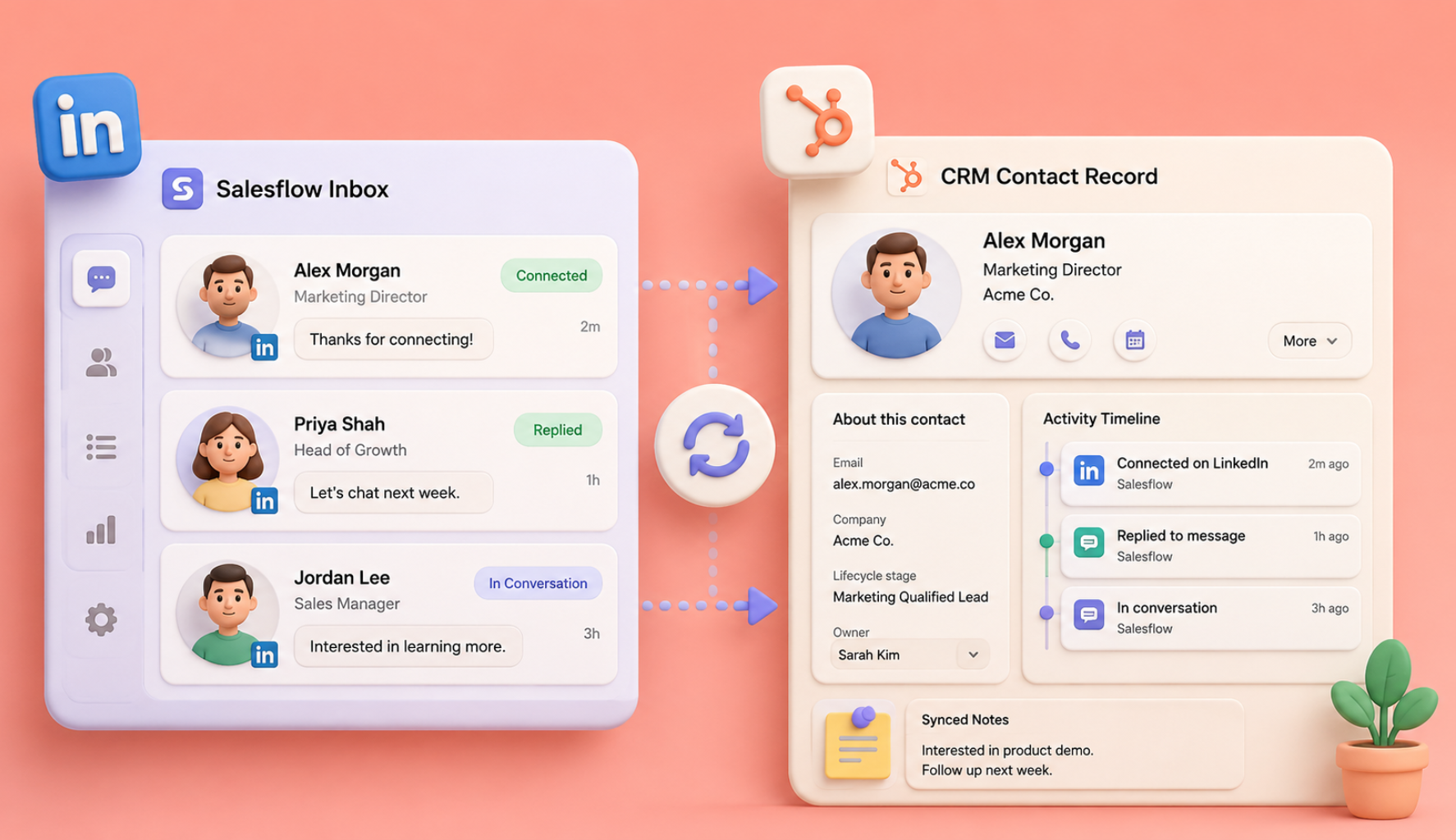
LinkedIn email automation works best when LinkedIn and email share one prospect journey instead of running as separate campaigns. LinkedIn can establish context and connection status; email gives you another route when a prospect is not connected or does not respond. A multichannel outreach platform can keep that logic in one sequence, pause after a reply, and route the next step based on what actually happened.
Salesflow now supports that model through Dynamic Outreach, which combines LinkedIn actions, email actions, waits, and conditions in one campaign. The workflow below keeps the useful idea from the original article, but removes fixed response-rate promises and outdated volume assumptions.
Why LinkedIn and email work better as one workflow
A missed connection request is weak evidence. The prospect may not use LinkedIn every day, may have reached an invitation limit, or may simply prefer email for work conversations. A coordinated second channel gives the same account another reasonable way to respond without sending the same message everywhere.
The channels should add context to each other. If you start on LinkedIn, the email can briefly mention the invite and then move straight to the business reason for contacting the person. If you start with email, the later LinkedIn touch can make your name familiar and give the prospect a profile to check. For the broader strategy, see why multichannel outreach works.
Tools needed
- Salesflow: build the LinkedIn and email sequence, set campaign limits and working hours, review replies, and route contacts based on status.
- A connected email account: use an authenticated mailbox for email steps and keep sending practices aligned with your provider requirements.
- A clean prospect list: import contacts from LinkedIn, Sales Navigator, CSV, your CRM, or another approved source. Only use data you are permitted to process and contact.
- Optional CRM, enrichment, or Zapier connection: use external systems only when they add data or trigger a handoff that the core sequence does not already handle.
If you are still choosing software, compare current multichannel outreach tools before adding several separate products to the workflow.
LinkedIn-first workflow: invite, follow up, then use email
Step 1: build a focused prospect list
Create one campaign around a specific audience, problem, and offer. Import the LinkedIn or Sales Navigator search, existing connections, or a CSV list. Keep enough fields to personalize the message, such as first name, company, role, and one reason the account belongs in the campaign.
Step 2: Choose the right LinkedIn first touch
For prospects who are not connected, a connection request may be the first step. For eligible Open Profiles, Open InMail can provide a direct route without waiting for a connection. Do not hard-code published monthly quotas into the article copy because product allowances, LinkedIn behavior, and account-level limits can change.
Step 3: Use conditions before the next step
The next action should depend on prospect state, not only on elapsed time. In Salesflow Dynamic Outreach, conditions can check whether a prospect is connected, whether Open InMail is available, whether an email exists, and whether an email was opened. That lets one campaign handle several outcomes without duplicating the list.
- If connected: send the relevant LinkedIn follow-up.
- If not connected but Open InMail is available: use Open InMail where the sequence calls for it.
- If email is available: add an email step when another channel makes sense.
- If a prospect replies: stop pending campaign actions and move the conversation to a person.
For the current builder logic, use the guide to condition-based LinkedIn and email sequences.
Step 4: Use email as a fallback, not a duplicate
When a LinkedIn path does not produce a reply, email can provide a second touch. Refer to the LinkedIn contact only when that context helps the prospect recognize you. Then add a specific reason for the email: a hiring signal, company change, public post, product launch, funding event, or another relevant trigger.
Avoid sending the same pitch on both channels. The second channel should answer a new question, add proof, or make the next step easier. That keeps the sequence from feeling like duplicated automation.
Step 5: Stop on reply and hand off
Automation should end when the conversation begins. Make reply detection and opt-out handling part of the workflow, then let a human answer in context. The goal is to remove repetitive campaign work, not automate the sales conversation after a prospect engages.
Email-to-LinkedIn workflow
The same model works in reverse. Start with email when you have a valid business address and a message that is easier to explain there, then use LinkedIn as a later touch for prospects who have not replied.
1. Launch the email sequence to one tightly defined segment.
2. After the planned email sequence ends without a reply, route only eligible prospects to the LinkedIn path.
3. Match the prospect to the correct LinkedIn profile before sending any action.
4. Use a connection request, profile visit, or Open InMail only when it fits the prospect state and your campaign rules.
5. Stop the remaining sequence as soon as the prospect replies on either channel.
If your CRM or email system already owns the first half of the process, a two-way Zapier or API connection can pass eligible prospects into Salesflow. Keep that handoff optional. The current Salesflow product can run LinkedIn and email together without requiring a separate email sequencer.
Email templates and practical rules
- Mention the earlier LinkedIn touch once. Do not spend half the email explaining that you sent an invite.
- Use one account-specific trigger so the message has a reason to exist.
- Keep one CTA. Ask for a small next step or a direct answer, not several actions.
- Stop after a reply or opt-out and suppress the contact from later campaign steps.
- Follow the commercial email rules that apply to your recipients and location.
In the US, FTC CAN-SPAM guidance states that the law also covers business-to-business commercial email. For UK outreach, review the ICO guidance for B2B marketing because PECR treatment can differ by recipient and business type.
Measure the workflow
There is no responsible universal multiplier for adding a second channel. Measure the sequence against your own single-channel baseline and decide whether the added touch improves qualified conversations without increasing complaints, opt-outs, or rep workload.
- LinkedIn connection acceptance rate.
- Positive reply rate by channel.
- Meeting rate and meeting-to-opportunity rate.
- Email bounce and opt-out rate.
- Time to first response and time spent managing campaign handoffs.
- Sequence completion rate and the branch where prospects most often stop.
Start LinkedIn and email outreach with one coordinated sequence
Keep the campaign logic simple enough to review: one audience, one reason to contact them, clear channel rules, and an immediate stop after a reply. Use email when it adds a useful second path, not because every prospect must receive every touch.
If your team wants a multichannel outreach platform for LinkedIn and email, review Salesflow Dynamic Outreach or start a 7-day free trial. Build the first sequence around one narrow segment, measure the response by branch, and adjust the message or route from your own campaign data.
.svg)


.png)